Policy Paper Series
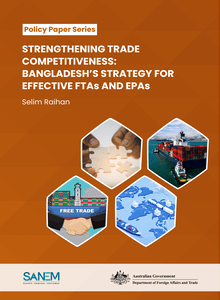
Strengthening Trade Competitiveness: Bangladesh’s Strategy for Effective FTAs and EPAs
Citation: Raihan, S. (2026). Strengthening Trade Competitiveness: Bangladesh’s Strategy for Effective FTAs and EPAs. SANEM & Australian High Commission Policy Paper Series. SANEM Publications, Dhaka, Bangladesh.
Bangladesh’s graduation from the Least Developed Country status is reflective of a significant transformation in its trade and development trajectory. The ready-made garments industry has been the backbone of export growth in the country for years, supported by preferential market access such as that granted by the European Union. This practice, however, is now faltering. A gradual erosion of trade advantages combined with a wave of new trade agreements between rival economies is changing the international trading landscape. As a result, Bangladesh faces an essential question: how can it safeguard and build on what has become its comparative advantage in trade amid fading preferences.
This paper argues that FTAs and EPAs are, hence, critical policy apparatus for navigating the transition but not a panacea. Their effectiveness depends on broader domestic reforms, institutional capacities, and strategic choices. The following analysis begins with a discussion of the changing global trade landscape and its implications – potential threats, including preference erosion, diversion of trade, and exclusion from new trade regimes. The assessment continues with the evaluation of existing and prospective FTAs and EPAs that Bangladesh is engaged in, including an EPA with major partners such as Japan and some others, which are still in the negotiation stage, particularly at the regional and plurilateral levels.
The paper identifies several critical challenges. Among these challenges are limited negotiating power, insufficient trade defense mechanisms, regulatory and administrative barriers, and structural vulnerabilities such as export concentration and dependence on import tariffs. If these shortcomings are not corrected, the benefits of trade agreements will likely be muted.
The paper offers a comprehensive strategic framework, divided into four interlinked pillars with wider guidance for action needed to answer these challenges. The first deals with the selection and ranking of trade partners on the grounds of economic robustness and strategic importance. The second focuses on building institutional capacity, including a negotiating unit and better trade defence systems. The third reinforces the need for domestic reforms, especially with respect to tariff rationalisation, customs modernisation, and export diversification. The fourth emphasizes the importance of proactive trade diplomacy, including through participation in multilateral forums and other complementary economic frameworks.
In closing, the paper provides a range of pragmatic policy orientations, starting with a National FTA Roadmap containing clear milestones and consistent monitoring. It emphasizes the need for trade policy to be embedded within a wider strategy across government and the economy as a whole. Bangladesh will ultimately use FTAs and EPAs as tools of sustainable and inclusive growth if it successfully strikes a balance between external leg and internal preparedness in trade engagement.