Policy Paper Series
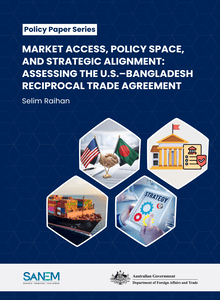
Market Access, Policy Space, and Strategic Alignment: Assessing the U.S.–Bangladesh Reciprocal Trade Agreement
Citation: Raihan, S. (2026). Market Access, Policy Space, and Strategic Alignment: Assessing the U.S.–Bangladesh Reciprocal Trade Agreement. SANEM & Australian High Commission Policy Paper Series. SANEM Publications, Dhaka, Bangladesh.
The Agreement between the United States and Bangladesh on Reciprocal Trade is far more than a conventional tariff arrangement. Its title suggests a trade agreement built around reciprocity. Its content, however, reaches deeply into Bangladesh’s domestic regulatory regime, industrial policy space, digital governance, labour law, environmental governance, customs administration, investment policy, public procurement choices, and strategic alignment on economic and national security matters. From Bangladesh’s perspective, this makes the agreement both consequential and highly sensitive.
The agreement offers one visible trade-side benefit: the United States would not apply the additional ad valorem duty under Executive Order 14257 on specified Bangladeshi originating goods, while for all other Bangladeshi originating goods, the additional rate would be capped at no more than 19 percent, in addition to the existing U.S. MFN rate. Bangladesh, in return, would undertake broad tariff liberalisation for U.S. goods, including the elimination or reduction of customs duty, supplementary duty, and regulatory duty across agreed product lines. The asymmetry is evident from the start. Bangladesh’s concessions appear broader, more intrusive, and more enforceable, while the U.S. tariff concession remains limited, conditional, and layered on top of existing MFN duties.
For Bangladesh, the core policy question is not whether closer trade relations with the United States are desirable. They clearly are. The United States remains a major export market, especially for apparel, and deeper commercial engagement could support investment, technology transfer, energy security, and market diversification. The harder question is whether this agreement, in its current form, advances Bangladesh’s long-term development interests on acceptable terms. On balance, the agreement appears to shift Bangladesh from a trade negotiation framework into a broad regulatory alignment framework, with significant implications for policy autonomy.
This paper argues that Bangladesh should approach the agreement with caution. Several provisions could support useful reforms, particularly in customs digitalisation, regulatory transparency, labour rights, anti-corruption, and trade facilitation. Yet many commitments are one-sided, highly detailed, and closely tied to U.S. commercial, regulatory, and security preferences. They may constrain Bangladesh’s ability to pursue industrial policy, manage digital sovereignty, design food and agricultural standards, negotiate future agreements with other partners, and maintain strategic balance in a complex geopolitical environment.
Bangladesh should not reject engagement with the United States. Nor should it accept a text that effectively converts trade access into a wide-ranging instrument of external policy discipline. The appropriate strategy would be to renegotiate, sequence, and narrow the commitments; secure clearer, legally binding U.S. market-access gains; protect Bangladesh’s development policy space; and establish a domestic review process involving Parliament, relevant ministries, regulators, private sector actors, labour organisations, consumer groups, and independent experts.