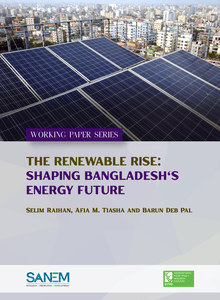
Working Paper Series
“The Renewable Rise: Shaping Bangladesh’s Energy Future”
Citation: Raihan, S., Tiasha, A.M., and Pal, B.D. (2026). The Renewable Rise: Shaping Bangladesh’s Energy Future. SANEM-IFPRI Working Paper Series. SANEM Publications, Dhaka, Bangladesh.
Abstract: Bangladesh’s energy sector is at a turning point as rising demand, rapid urbanisation, and climate pressures collide with a system still dominated by natural gas and traditional biomass, while modern renewables remain marginal. The paper argues that an energy transition is unavoidable because climate change is already disrupting power generation and infrastructure, and fossil‑fuel dependence is driving up emissions, import vulnerability, and fiscal stress. NDC 3.0 places the energy sector at the centre of national mitigation efforts, setting targets for renewable expansion, grid efficiency, clean transport, industrial efficiency, rooftop solar, and clean cooking. Policy frameworks exist, but fragmented targets and weak coordination undermine investor confidence and slow implementation. Using a dynamic CGE model, the study shows that renewable expansion, efficiency gains, and reduced system losses can significantly raise GDP, create millions of jobs, lift households out of poverty, and strengthen energy security by reducing import dependence. Renewable energy delivers the strongest economic and social gains, especially for poorer households. The paper concludes that Bangladesh’s energy transition must prioritise coherent targets, stronger institutions, decentralised and climate‑resilient infrastructure, and large‑scale finance mobilisation. If implemented effectively, the shift to clean energy can become a major driver of growth, resilience, and poverty reduction, turning a climate necessity into a development opportunity.