Thinking Aloud: Volume XIII, Issue 4: September 1, 2026
The September issue examines three areas where Bangladesh’s economic transformation faces important structural challenges. From economic stability and energy security to digital financial inclusion, this issue explores how short-term measures can provide relief, but lasting progress requires credible policies, institutional capacity, and sustained implementation. Here’s what’s inside:
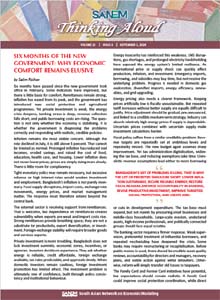
“Six Months of the New Government: Why Economic Comfort Remains Elusive” by Selim Raihan
The article assesses Bangladesh’s economic situation six months into the new government, arguing that despite some improvements, significant challenges remain. Persistent inflation, weak private investment, energy insecurity, fiscal pressures, and banking sector distress continue to undermine economic stability and public confidence. The article stresses that strong remittances alone cannot substitute for export diversification and productive investment, while reliable energy and predictable policies are essential for restoring investor confidence. It also highlights the need for stronger accountability in banking, realistic fiscal planning, and evidence-based expansion of social protection initiatives such as the Family Card and Farmer Card. The article concludes that economic policy should focus on a short set of priorities: sustainable inflation reduction, reliable energy, fiscal realism, banking reform, productive investment, targeted social protection, and job creation.
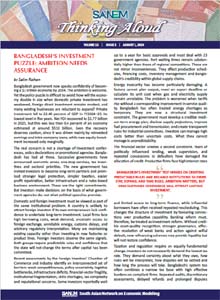
“Bangladesh’s Gas Squeeze: A Structural Problem, Not Just a Bad Season” by Md. Tuhin Ahmed
The article argues that Bangladesh’s gas crisis is not a temporary disruption but the result of longstanding structural weaknesses in the energy sector. The country is now vulnerable to outside shocks due to domestic gas production, increased reliance on imports, and weaknesses in LNG infrastructure. These are disrupting households, industries, and power generation. Public finances are also being further strained by reliance on expensive spot-market LNG. The article calls for more domestic gas exploration, reduced system losses, diversified import sources, strategic reserves, and stronger procurement practices. It also emphasizes increasing regional energy cooperation and accelerating the shift to renewable energy. The crisis should lead to structural reform rather than another cycle of temporary emergency measures.
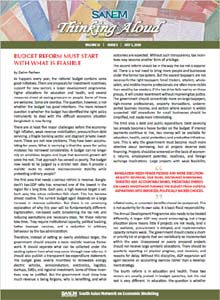
“From One QR Code to Digital Financial Inclusion: Where Bangla QR Stands” by Takrem Ferdous Surid
The article observes how Bangla QR could advance digital financial inclusion by making digital payments more accessible to merchants and consumers. The unified QR system solves the inconvenience of multiple payment platforms. But the removal of the Interchange Reimbursement Fee does not mean that the cost is removed from the merchants. It suggests the possible advantages of digital transactions, like increased transparency, formal financial records, and better credit access for small businesses. However, sustained adoption will require affordable fees, continued incentives, broader access to smartphones and the internet, and increased government adoption. The article recommends a defined long-term strategy beyond the incentive period, more rapid development of offline functionality and a measure of actual usage rather than just the number of QR codes issued.
Across economic management, energy security, and digital finance, this issue of Thinking Aloud highlights the need to move beyond short-term responses towards lasting structural solutions. As Bangladesh navigates these challenges, the ability to turn policy initiatives into sustainable outcomes will be critical. Dive into the insights!