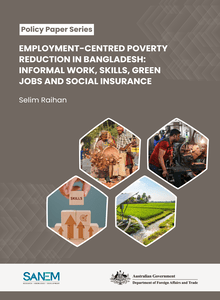
Policy Paper Series
Employment-Centred Poverty Reduction in Bangladesh: Informal Work, Skills, Green Jobs and Social Insurance
Citation: Raihan, S. (2026). Employment-Centred Poverty Reduction in Bangladesh: Informal Work, Skills, Green Jobs and Social Insurance. SANEM & Australian High Commission Policy Paper Series. SANEM Publications, Dhaka, Bangladesh.
This policy paper argues that Bangladesh’s next phase of poverty reduction must be centred on employment rather than relying on economic growth and social assistance alone. Although poverty declined substantially over the past decade, the labour-income channel has weakened, vulnerability remains widespread, and employment growth has been concentrated in low-productivity and informal activities.
The paper, therefore, examines how job quantity, job quality, skills, green employment and social insurance can be brought together within a coherent poverty-reduction strategy. It highlights the limitations of the headline unemployment rate and stresses the need to track labour-force participation, earnings, underemployment, informality, occupational mobility and social protection coverage, with particular attention to women, youth and spatial disparities.
The analysis identifies persistent informality, weak links between training and employment outcomes, limited diversification beyond garments, and inadequate protection against income shocks as central constraints. It proposes a gradual formalisation strategy based on visible benefits, outcome-based skills financing, recognition of prior learning, expansion of green occupations linked to renewable energy, industrial efficiency, climate-smart agriculture, waste management and resilient infrastructure, and a sequenced social insurance architecture beginning with employment injury protection.
The paper further recommends an integrated Employment and Social Protection Framework, stronger labour-market data systems, transparent worker registries, portable benefits and clearer institutional accountability. Implementation must recognise fiscal constraints, uneven administrative capacity, employer incentives, and workers’ concerns about governance. Its central conclusion is that poverty reduction will become more durable only if productivity, labour earnings, job mobility and protection against shocks are strengthened together through feasible, sequenced and politically realistic reforms.