Policy Paper Series
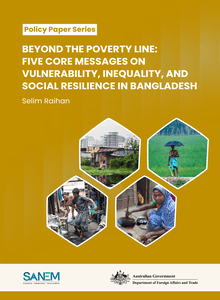
Beyond the Poverty Line: Five Core Messages on Vulnerability, Inequality, and Social Resilience in Bangladesh
Citation: Raihan, S. (2026). Beyond the Poverty Line: Five Core Messages on Vulnerability, Inequality, and Social Resilience in Bangladesh. SANEM & Australian High Commission Policy Paper Series. SANEM Publications, Dhaka, Bangladesh
Bangladesh has made substantial progress in reducing poverty over the past few decades, supported by sustained economic growth, expansion of the ready-made garments sector, remittances, rural transformation, women’s economic participation, and improvements in human development. Yet this progress remains incomplete and increasingly fragile. This paper argues that Bangladesh’s next poverty challenge is not only to reduce the poverty headcount further, but to address the wider problem of vulnerability among households living just above the poverty line. Many of these households lack savings, secure employment, insurance, and reliable social protection, making them highly exposed to illness, job loss, food inflation, climate disasters, and other shocks.
The paper develops five core messages. First, poverty has declined, but vulnerability remains a central development concern, particularly among the near-poor. Second, persistent poverty is closely linked to weak labour-market transformation, informal employment, low wages, and the limited expansion of productive non-farm and medium-sized enterprise sectors. Third, rising inequality is reducing the inclusiveness of poverty reduction and weakening the poverty-reducing effect of growth. Fourth, marginalised groups, including women-headed households, persons with disabilities, elderly people, children, ethnic minorities, urban slum residents, migrants, and climate-exposed communities, face overlapping disadvantages that generic poverty programmes often fail to address. Fifth, climate change, inflation, and repeated economic shocks are creating a new poverty landscape in which households face simultaneous pressures on income, consumption, health, assets, and livelihoods.
The paper calls for a shift from a narrow poverty-reduction framework to a broader resilience-building agenda. This requires shock-responsive social protection, decent employment creation, redistributive public investment, inclusive programme design, climate-resilient livelihoods, inflation-sensitive transfers, and stronger institutional capacity. Bangladesh’s achievement remains significant, but the harder task ahead is to ensure that those who have escaped poverty can remain above the poverty line with dignity, security, and real prospects for upward mobility.