
Thinking Aloud: Volume XII, Issue 11: April 1, 2026
The April issue looks at three challenges Bangladesh can no longer defer— a budget caught between immediate pressures and long-term transition, an education reform with the right ideas but uncertain delivery, and a seismic risk Bangladesh has consistently underestimated. Here’s what’s inside:
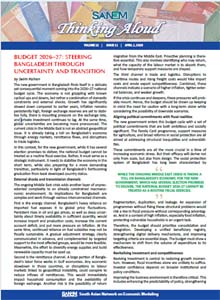
“Budget 2026–27: Steering Bangladesh Through Uncertainty and Transition” by Selim Raihan
The article examines the challenges facing Bangladesh’s 2026-27 budget with slowing growth, persistent inflation, and a Middle East crisis already weighing on energy costs, remittances, and trade. The budget must serve as a strategic instrument rather than a routine fiscal exercise, balancing short-term stabilisation with LDC graduation pressures. The article stresses that social protection expansion, banking reform, investment revival, and tax base broadening are all necessary but their effectiveness depends on coherence across fiscal, monetary, and structural policies.
“Bangladesh’s Education Reform: Between Promise and Delivery” by Selim Raihan and Shafa Tasneem
The article centers around the argument that while Bangladesh’s education system has made remarkable progress in access, learning outcomes tell a harder story. SANEM-ActionAid’s Youth Survey 2025 found more than half of educated youth felt unprepared for the job market. The article examines the newly elected government’s 12-point education reform agenda spanning curriculum modernisation, digital access, mandatory internships, and pedagogical reforms. While the proposals are directionally right, fiscal underutilisation, curriculum disruption, and coordination gaps could derail delivery.
“Are We Prepared to Pay? Economic Risks of Earthquakes in Bangladesh” by Sudeepto Roy
The article warns that Bangladesh’s earthquake risk is no longer distant. 40 tremors struck within or along its borders in 2025-26, with a major quake of magnitude 8.2 to 9 possible. Global modelling suggests losses exceeding $60 billion and over 100,000 deaths. Myanmar, Nepal, and Turkey all confirm that unenforced building codes offer no real protection. Bangladesh has the codes but not the institutional will to enforce them. Paying now for structural assessments and retrofitting is far cheaper than the alternative.
The pressures facing Bangladesh are no longer on the horizon, they are already here. This issue of Thinking Aloud maps what is at stake: a budget that must stabilise and transform at once, an education system whose reform promises must survive the implementation test, and a country that cannot afford to wait for the next earthquake to act. Dive into the insights!


