
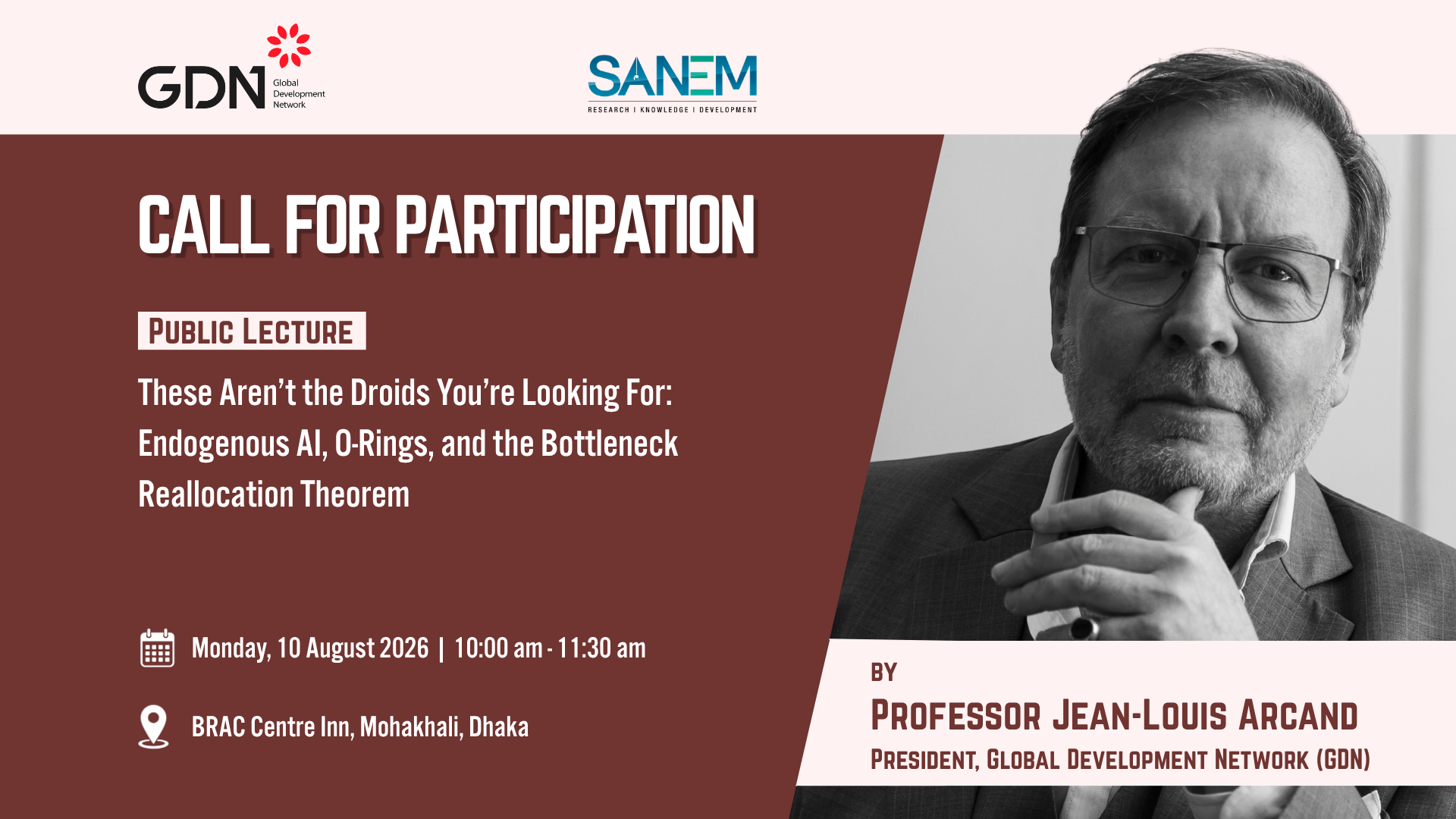
CALL FOR PARTICIPATION
Public Lecture
These Aren’t the Droids You’re Looking For: Endogenous AI, O-Rings, and the Bottleneck Reallocation Theorem
by Professor Jean-Louis Arcand, President, Global Development Network (GDN)
About the Speaker
Professor Jean-Louis Arcand is a Canadian economist and professor of economics at the Graduate Institute of International and Development Studies in Geneva, as well as an affiliate professor at the Université Mohammed VI Polytechnic in Rabat. He is a Founding Fellow of the European Development Research Network (EUDN), a Senior Fellow at the Fondation pour les études et recherches en développement international (FERDI) and has been a Visiting Professor at Renmin University of China in Beijing, Universidade Federal da Bahia and several universities in Africa and the Caribbean. He was assistant and then Associate Professor at the University of Montréal, and Professor at the Centre d’études et de recherches en développement international (CERDI).
Jean-Louis holds a PhD in Economics from the Massachusetts Institute of Technology (MIT), an MPhil from Cambridge University and a BA (high honors) from Swarthmore College. He became the president of GDN in January 2023.
About the Lecture
The lecture presents recent joint work by Professor Arcand and Mr Balasubramanyam Pattath, which extends Michael Kremer’s celebrated O-ring theory of production to the age of artificial intelligence. In the O-ring framework, production is a chain of complementary tasks in which a single failure destroys the value of everything else, which is why small differences in skill translate into very large differences in output between countries. The paper asks what happens when AI is introduced into such a chain as a technology that reduces the probability of failure.
The answer is counterintuitive. Because AI substitutes for worker quality within a task but complements it across tasks, firms deploy AI where the return is highest, and adoption gravitates towards the weakest link in the chain. That link improves, and another task becomes the binding constraint. AI therefore does not dissolve the O-ring mechanism, it relocates it, a result the authors call the Bottleneck Reallocation Theorem. The paper tests the model’s predictions against experimental data on radiologists and against occupation-level evidence on where AI is actually used, finding that AI intensity falls as worker quality rises within a task, while the stakes attached to failure drive adoption where the value of not failing is highest. Calibrated to current adoption levels, the model implies a one-off aggregate output gain of roughly half a per cent net of AI costs, with essentially no wage compression today and compression arriving only as the cost of AI falls. This helps reconcile the wage compression found in controlled experiments with the null aggregate wage effects observed in administrative labour market data.
The findings carry a direct and unexpected message for countries such as Bangladesh. Anchoring national skill distributions to international literacy data, the model implies that lower-skill economies gain more from AI at every level of task complexity, a conditional convergence result. The condition, however, is that adoption costs are equal. Any divergence between rich and poor countries operates not through the scarcity of skills but through the cost of adopting the technology, which places digital infrastructure, connectivity, electricity, and complementary institutional investment at the centre of the policy agenda.
Who Will Be Joining
The lecture is open to all who are interested in the subject. Participants are expected to include:
- Researchers and academics from universities and research institutions
- Representatives of think tanks and policy research organisations
- Students of economics, development studies and related disciplines
Participation is by Registration
Please fill out the Google Form to join: https://forms.gle/TCQiZ79PS5GhsF9E6